Directory Structure
A fresh uvicore project called acme.wiki built with the Uvicore Installer will have the following folder structure.
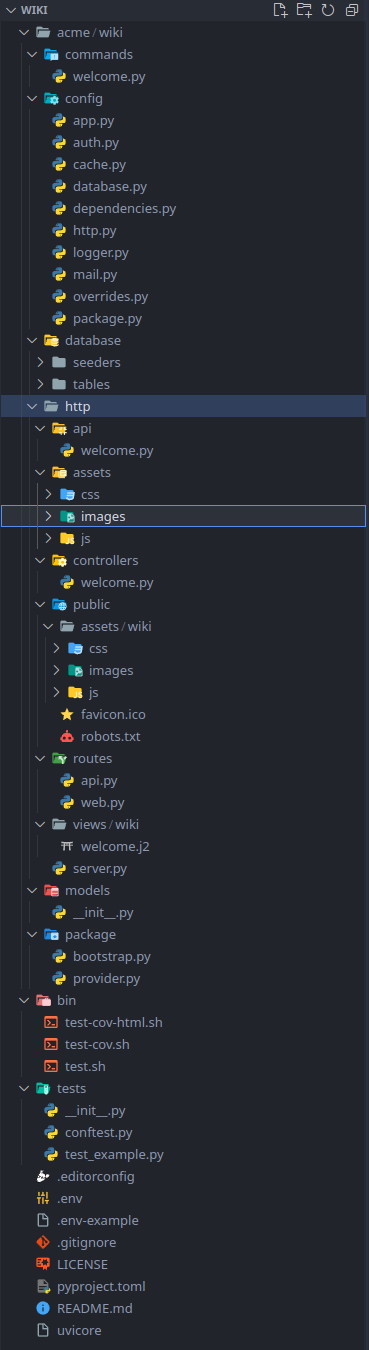
Uvicore is opinionated about structure so that every project feels familiar. When you (or a teammate) open any Uvicore app, you already know where everything lives. Remember the Modular Concept, your package is the app, so this structure is all there is, no outer "shell" project wrapping it.
The Package Root
At the top level you will find the entry points and project files:
| Path | Purpose |
|---|---|
./uvicore |
The CLI entry point. Run ./uvicore to see your commands, ./uvicore http serve to start the dev server. |
serve-uvicorn / serve-gunicorn |
Convenience scripts to serve the app in production with Uvicorn or Gunicorn. |
.env |
Your environment-specific values. Copied from .env-example at install. |
pyproject.toml |
Your package definition and dependencies (Poetry). |
tests/ |
Your pytest suite. |
acme/wiki/ |
Your actual Python package, everything below lives here. |
Inside Your Package
Everything that makes your app your app lives under acme/wiki/ (your chosen vendor/package namespace).
acme/wiki/
  commands/          CLI command modules
  config/            All of your configuration files
  database/
    seeders/         Data seeders
    tables/          SQLAlchemy table definitions
  http/
    api/             API controllers
    controllers/     Web controllers
    public/          Browser-served files (favicon, robots.txt)
      assets/        Static CSS, JS and images
    routes/          web.py and api.py route registration
    views/           Jinja2 (.j2) templates
    server.py        The ASGI HTTP entry point
  models/            ORM models
  package/
    bootstrap.py     Bootstraps the app (CLI and HTTP entry points)
    provider.py      The Package Provider, your app's hub
package/
The heart of your app. package/provider.py is the Package Provider where you wire up everything your app offers, config, routes, models, commands and more. package/bootstrap.py is the shared bootstrap used by both the CLI and HTTP entry points.
config/
Your configuration, split by concern for a great developer experience. The two most important files are config/package.py (always applies) and config/app.py (applies only when your package is the running app). The rest, http.py, database.py, auth.py, cache.py, mail.py, logger.py, overrides.py, dependencies.py, are imported into those two.
commands/
Your async CLI commands. Each command is registered with the CLI from your provider.
database/
Your tables and seeders. Your ORM models live one level up in models/ since a model is a higher-level entity than a table.
http/
Everything HTTP. Web routes and controllers render views; API routes and controllers return data. Static files live in public/ and public/assets/, and server.py is the ASGI app that Uvicorn/Gunicorn serve.
models/
Your ORM models, the rich Python entities mapped to your database tables.
Customizing Paths
These locations are the sensible defaults, but they are not rigid. The paths section of your config/package.py lets you remap any of them (and is what the ./uvicore gen generators use to know where to place new files).
Tip
Stick with the defaults unless you have a strong reason not to. Consistent structure across Uvicore projects is a feature, it means every app, yours or a community package, reads the same way.